
Introduction
Chameleónovité are among the most unusual and highly adapted reptiles in the world. While many people immediately think of color changing skin, the reality is far more complex. The family Chameleónovité represents a group of lizards that have evolved unique physical structures, survival strategies, and communication systems over millions of years. Their biology reflects precision, specialization, and adaptation to diverse environments.
The word Chameleónovité refers to the taxonomic family that includes all chameleon species. These reptiles are primarily found in Africa and Madagascar, with a few species living in parts of southern Europe and Asia. Today, scientists recognize over 200 species within the Chameleónovité family, making them one of the most diverse reptile groups in tropical ecosystems.
This article provides a detailed exploration of Chameleónovité, including their evolution, anatomy, behavior, habitat, reproduction, ecological importance, and conservation challenges.
Evolution and Scientific Classification
Chameleónovité belong to the class Reptilia and the order Squamata, which includes lizards and snakes. Within this order, they form a distinct family due to their specialized features. Fossil evidence suggests that early ancestors of Chameleónovité appeared millions of years ago, likely originating in Africa before spreading to nearby regions.
Madagascar as the Center of Diversity
Madagascar is considered the center of diversity for Chameleónovité, as nearly half of known species are native to this island. The geographic isolation of Madagascar allowed many species to evolve independently, resulting in extraordinary variation in size, coloration, and body structure.
Evolutionary Specialization
Unlike other lizard families, Chameleónovité developed a unique combination of grasping feet, independently moving eyes, and projectile tongues. These features are not random traits but the result of long term adaptation to arboreal life in forests and shrubs.
Unique Physical Adaptations
Color Transformation Mechanism
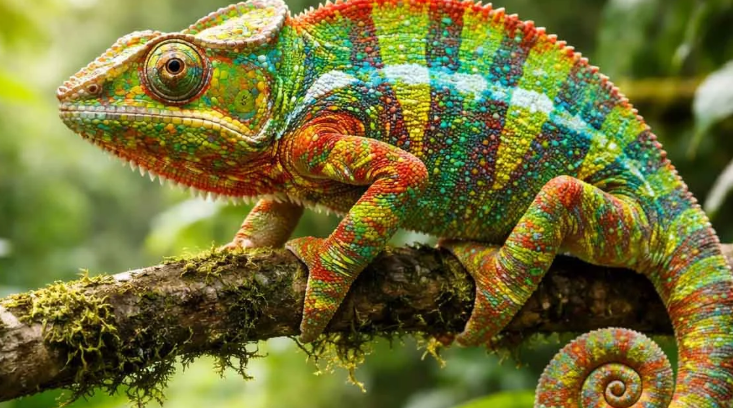
The most recognized feature of Chameleónovité is their ability to change color. However, this ability is not simply camouflage. Color shifts are often triggered by mood, temperature, stress, social interaction, or territorial behavior.
The skin of Chameleónovité contains layered cells with pigments and microscopic crystal structures. When these layers shift, light reflects differently, creating visible color changes. Bright patterns may signal dominance or mating readiness, while darker shades can indicate submission or stress.
Advanced Visual System
Another extraordinary feature of Chameleónovité is their visual system. Each eye moves independently, allowing them to scan nearly their entire surroundings without turning their head. This provides a wide field of vision and reduces vulnerability to predators.
When focusing on prey, both eyes align forward to measure distance accurately. This dual function system enhances hunting precision and supports their ambush based feeding strategy.
Specialized Feet and Tail
Members of the Chameleónovité family have feet structured like pincers. Their toes are fused into opposing groups that grip branches securely. This adaptation allows slow and steady movement through trees.
Most species also possess a prehensile tail. The tail wraps around branches to provide balance, acting almost like an extra limb. This feature supports their primarily arboreal lifestyle.
The Elastic Tongue Mechanism
Perhaps the most remarkable adaptation of Chameleónovité is their tongue projection system. Their tongues can extend well beyond their body length and strike prey in a fraction of a second. Elastic connective tissues store energy, releasing it rapidly to launch the tongue forward.
The tip of the tongue is muscular and sticky, ensuring a firm grip on insects. This hunting method minimizes energy use while maximizing success.
Habitat and Geographic Distribution
Chameleónovité inhabit warm climates with varying levels of humidity. Their habitats include tropical rainforests, dry woodlands, mountain regions, and semi arid areas. Most species are tree dwelling, although some live in bushes or near ground level.
Global Distribution
Madagascar holds the greatest species diversity, but mainland Africa also supports a wide range of Chameleónovité populations. A small number of species exist in southern Europe and parts of Asia.
Environmental Sensitivity
These reptiles depend heavily on stable environmental conditions. Temperature, vegetation density, and insect availability directly influence their survival. Habitat destruction therefore poses a serious threat to many species.
Behavior and Social Structure
Chameleónovité are generally solitary animals. They do not form social groups and interact mainly during breeding seasons or territorial disputes. Males are particularly territorial and may display bright colors and expanded body posture to warn rivals.
Movement and Camouflage Behavior
Movement among Chameleónovité is slow and deliberate. They often sway gently while walking, imitating leaves moving in the wind. Both predators and prey are less likely to notice this activity.
Communication Methods
Communication within the Chameleónovité family relies heavily on visual signals. Body posture, color patterns, and head movements communicate aggression, readiness to mate, or submission.
Diet and Feeding Strategy
Most Chameleónovité species are insectivores. Their diet commonly includes crickets, grasshoppers, beetles, flies, and other small invertebrates. Larger species may consume small vertebrates such as lizards or nestling birds.
Hunting Technique
Hunting behavior is based on patience. A chameleon may remain motionless for long periods while observing its surroundings. Once prey enters range, the tongue launches with incredible speed and accuracy.
This ambush strategy conserves energy and reduces risk. The combination of advanced vision and rapid tongue projection makes Chameleónovité highly efficient predators.
Reproduction and Development
Reproductive patterns vary within Chameleónovité. While some species give birth to live offspring, most species lay eggs. Egg laying females dig shallow nests in soil to protect their clutch.
Incubation and Growth
Incubation periods differ widely depending on species and environmental conditions. Some eggs hatch within several months, while others may take nearly a year. Hatchlings are independent immediately after birth and receive no parental care.
Lifespan
Lifespan also varies. Smaller species may live only a few years, while larger members of Chameleónovité can survive up to a decade under favorable conditions.
Ecological Role
Chameleónovité play an important ecological role as insect regulators. By feeding on large numbers of insects, they help maintain balance within ecosystems. Mammals, birds, and snakes also rely on them as a food source.
Indicators of Environmental Health
Because of their sensitivity to environmental changes, Chameleónovité can act as indicators of ecosystem health. Declining populations often signal habitat disturbance or climate instability.
Their presence contributes to biodiversity and strengthens ecological networks in tropical and subtropical regions.
Conservation Challenges
Many Chameleónovité species face increasing threats from deforestation, agriculture expansion, and illegal wildlife trade. Habitat fragmentation reduces breeding areas and limits food availability.
Impact of Climate Change
Climate change also affects temperature and rainfall patterns, directly influencing their survival. Since Chameleónovité rely on specific environmental conditions, even small climate shifts can have serious consequences.
Conservation Strategies
Conservation strategies include habitat protection, trade regulation, public education, and scientific research. Sustainable environmental management is essential to preserve these unique reptiles for future generations.
Scientific and Cultural Significance
Chameleónovité have inspired scientific research in vision technology, biomechanics, and material science. Their skin structure has influenced studies in adaptive materials, while their eye movement system inspires camera and robotics design.
Culturally, chameleons symbolize change, adaptability, and transformation. Their distinctive appearance has made them subjects in art, folklore, and storytelling across many societies.
Adaptation to Different Environments
Chameleónovité demonstrate how precise adaptation allows species to survive in highly specific environments. Some members thrive in dense tropical forests, while others live in dry savannas or mountainous regions. Their body size, coloration, and behavior often match their habitat conditions.
These variations show how Chameleónovité have evolved to fill different ecological roles while maintaining their core physical traits.
Scientific Importance and Ongoing Research
The study of Chameleónovité continues to attract scientific attention across multiple fields. Researchers examine their skin to understand how microscopic structures create rapid color change. Their independently moving eyes provide valuable insights into visual coordination and depth perception.
The tongue projection system of Chameleónovité is also studied in biomechanics because of its speed and accuracy. These reptiles offer real scientific value and inspire research in biology, robotics, and material science.
Future Conservation and Environmental Awareness
The long term survival of Chameleónovité depends on global conservation efforts and responsible environmental practices. Habitat loss, illegal wildlife trade, and climate change remain serious threats to many species within this family.
Protecting forests, supporting conservation programs, and promoting awareness about biodiversity are essential steps toward ensuring their survival. By valuing and protecting Chameleónovité, humans also help preserve ecological balance and environmental health.
Conclusion
Chameleónovité represent one of the most specialized reptile families in the animal kingdom. Their color transformation system, independent eye movement, gripping limbs, and elastic tongue mechanism highlight millions of years of evolutionary refinement.
Beyond their physical uniqueness, Chameleónovité play essential ecological roles and serve as indicators of environmental health. However, habitat destruction and climate change threaten many species within this remarkable family.
Understanding Chameleónovité encourages greater appreciation for biodiversity and the complexity of natural adaptation. Protecting their habitats ensures that these extraordinary reptiles continue to thrive as part of Earth’s delicate ecological balance.
Read also How Ignition Coil Tests Save Time and Money